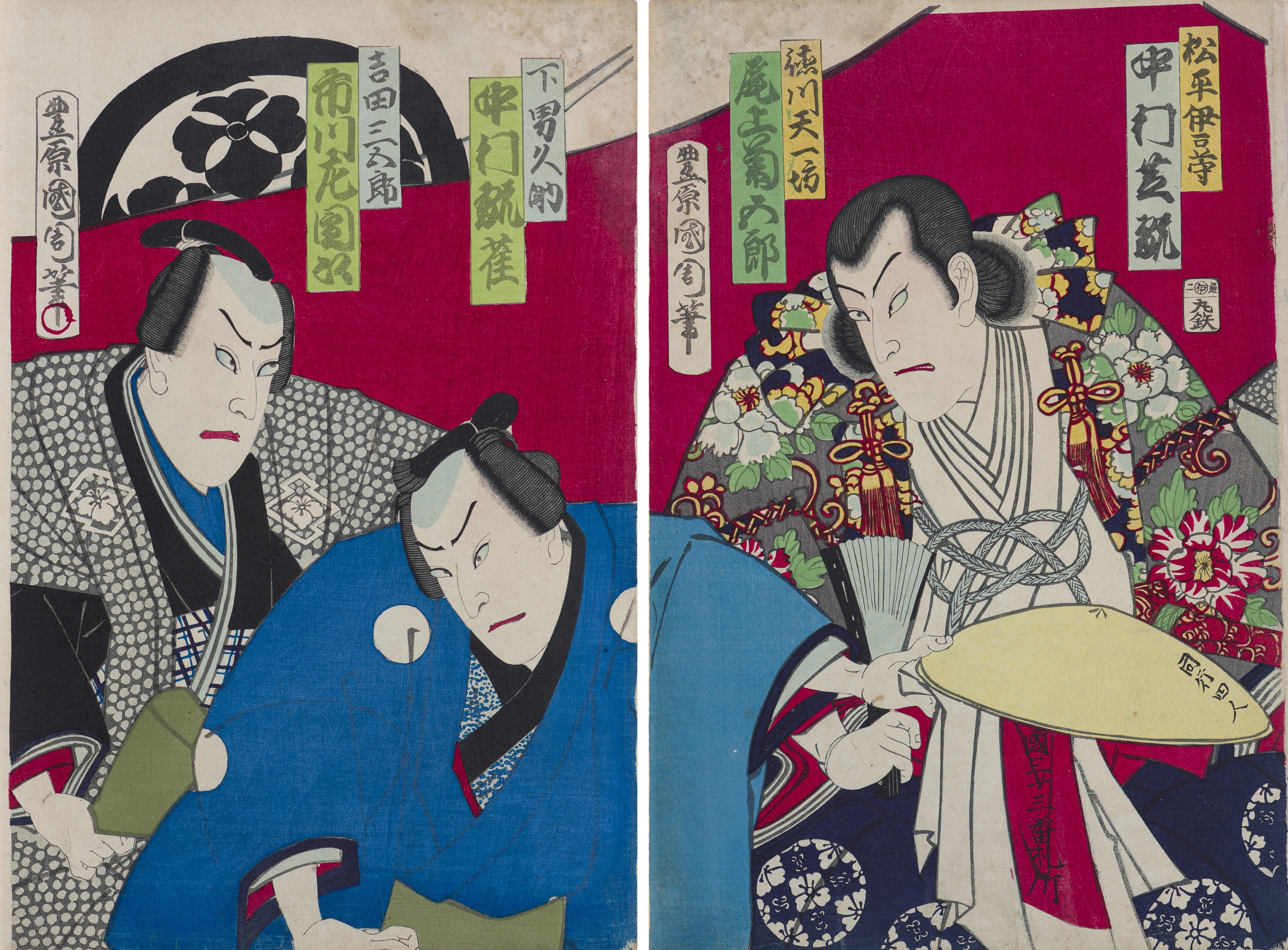
color woodcut, ink on paper, 36 x 48 cm (2 x 36 x 24 cm), artist’s signature, publisher’s mark, and full date, two sheets joined as a diptych, double-layered paper, minor soiling in the corners
An identical piece is held at the Tokyo Metropolitan Library.
The work *Ōgi Byōshi Ōoka Seidan* (loosely translated: “Tales of Judge Ōoka Written on a Fan”) is based on a real scandal from 1729. A young monk named Ten’ichibō poses as the illegitimate son of the ruling shogun, Tokugawa Yoshimune. Thanks to forged documents and his immense charisma, he manages to recruit a large following, including samurai. His goal is to infiltrate and seize power within the shogunate. The drama centers on an investigation led by the legendary, just judge from Edo—Ōoka Echizen no Kami. The judge is the only one who remains skeptical of the alleged prince’s claims. An intellectual and political game of deception begins, in which Ōoka must prove Ten’ichibō’s fraud before the plot leads to a rebellion and a bloody coup. Ultimately, the conspiracy is uncovered, and the impostor is sentenced to death.
Born in 1835, Toyohara Kunichika grew up in the Kyobashi district of Edo among merchants and artisans. In 1848, at the age of 13, he was accepted as an apprentice in the studio of Utagawa Kunisada I (Toyokuni III, 1786–1865). He was known as one of the “Three Great Meiji Ukiyo-e Artists,” along with Tsukioka Yoshitoshi (1839–1892) and Kobayashi Kiyochika (1847–1915). In 1869, he began publishing a series of portraits of kabuki actors. As a printmaker specializing in yakusha-e (actor prints), Kunichika was a regular visitor behind the scenes at the Kabuki theater. He made sketches of the actors before and during performances, as well as during rehearsals. He possessed in-depth knowledge of every aspect of the theater, being well acquainted with the plays, playwrights, actors, and their acting styles. Unlike most artists of that period, he used strong reds and dark purples—often as background colors—instead of the more delicate colors that had previously been used. These new colors were produced using aniline dyes imported from Germany during the Meiji period. Kunichika’s work contrasts with that of many of his contemporaries, as he steadfastly adhered to the traditional style and themes of classical Japanese woodblock prints, resisting the influence of new Western art forms. His love for kabuki inspired him to depict actors in their various roles and with a range of facial expressions. His skillful use of color and ability to convey the depth of an actor’s emotions on the page make his works among the most dramatic ever created. Later in his career, Kunichika turned primarily to the triptych format, as the larger size gave him the space to fully depict the drama and action of the characters portrayed.
Kunichika died at his home in Honjo on July 1, 1900, at the age of 65, due to poor health and bouts of heavy drinking triggered by the death of his daughter Hana in 1899. He was buried at the Shingon Honryuji Buddhist temple in Imado, Asakusa. His tombstone was destroyed during the 1923 earthquake, but his family erected a new one in 1974. In ancient Japan, it was a common custom for people of high cultural standing to write a poem before their death. Kunichika’s grave bears his poem: “Since I am tired of painting portraits of the people of this world, I will paint portraits of Enma (the King of Hell) and demons.”