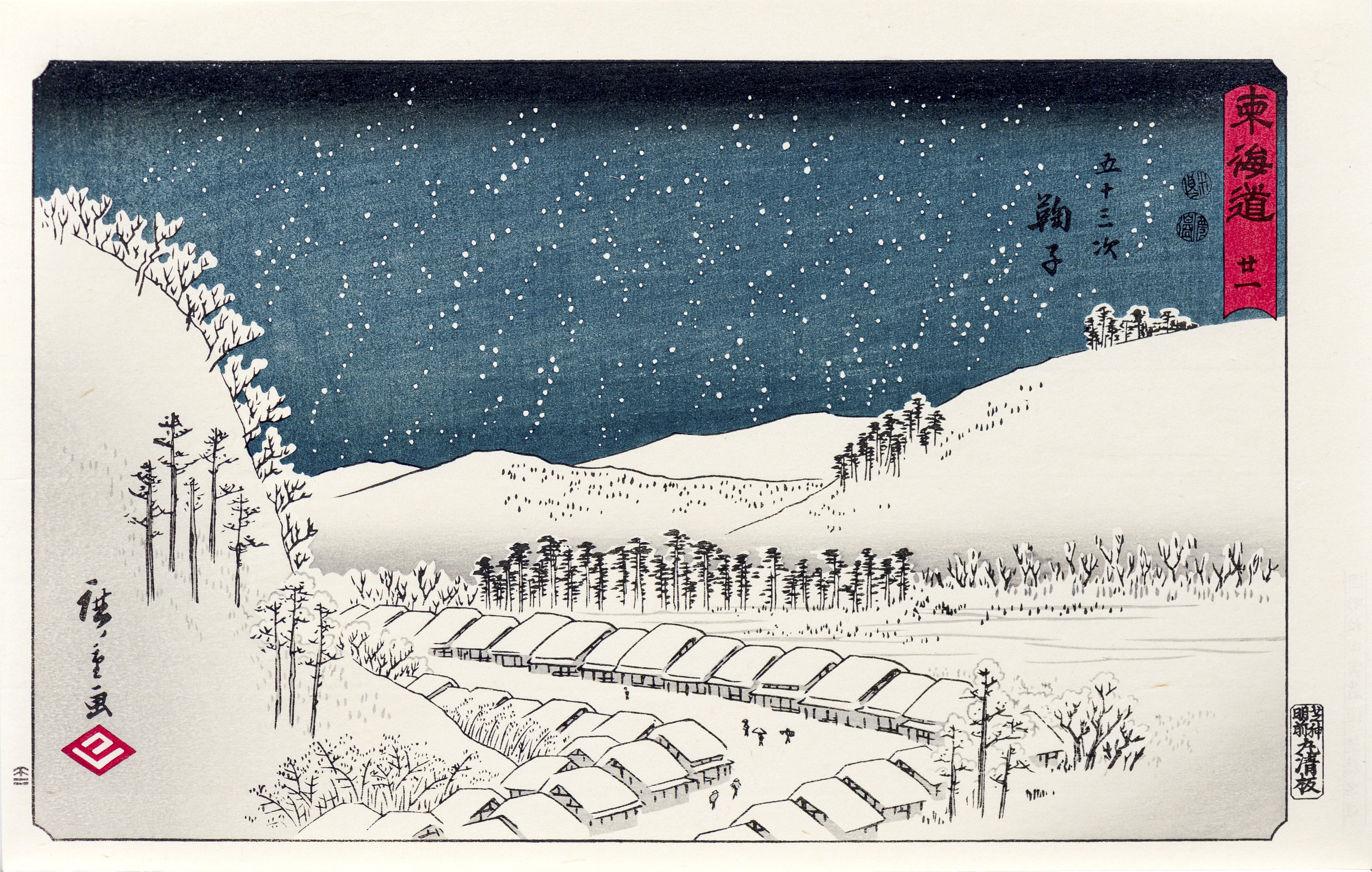
Color woodcut, paper, 25x39 cm, artist’s signature, publisher’s mark in the margin, on the verso: craftsmen’s credits: carved by Torazo Matsuda, printed by Tadao Endo.
A beautiful and rare reprint prepared by masters associated with the Yuyudo publishing house. The work depicts an idyllic winter scene of a small village hidden in a snow-covered valley. Here one can see neat rows of traditional rural houses and inns covered with a thick, white layer of snow. The lines of the roofs form a rhythmic pattern that draws the viewer’s eye deeper into the composition. On the left rises a steep, snow-covered slope with slender coniferous trees characteristic of the Japanese landscape. In the background, gentle, snow-capped mountain ridges loom beneath a navy-blue sky. A key element that sets the mood of this composition is the hundreds of tiny white dots imitating heavy snowfall. They stand out clearly against the dark blue sky, creating a strong contrast with the white ground.
Ukiyo-e woodblock prints have been produced since the Edo period, always using traditional methods. Since the early 20th century, the Yuyudopublishing house has distinguished itself as one of the finest publishers in Japan. It adhered to the same rigorous standards as 19th-century publishers, while some of its peers cut corners. In the 1950s, as interest in Edo-period woodblock prints resurged, Yuyudo launched a project to reprint the works of the great masters from the golden age of ukiyo-e. To this end, they hired the world’s finest printers and woodcarvers. The resulting works are among the highest-quality editions ever produced. Yuyudo’s woodblock prints are exceptionally well-crafted and meticulously executed. The publishing house ceased operations in the 1980s.
Hiroshige Andō, also known as Hiroshige Utagawa, is one of Japan’s most famous painters and printmakers. His father, Andō Genuemon, was a low-ranking samurai and an officer in the fire brigade. From the age of sixteen, Hiroshige trained in the studio of Utagawa Toyohira, under whose guidance he developed his skills and talent. The young Hiroshige soaked up the artistic atmosphere while also helping out with the day-to-day operations of his father’s fire brigade. It wasn’t until he was 27 that he decided to fully commit to a career in the arts. After his teacher’s death in 1822, he was offered the chance to take over his master’s studio, but Hiroshige declined the offer and chose to work independently. Hiroshige’s artistic output has not yet been fully cataloged, but it is estimated that he produced approximately 5,000 works, primarily in the technique of color woodblock printing. He began his career with portraits of beautiful women (bijin-ga) and images of kabuki actors (yakusha-e), but after his teacher’s death, he focused primarily on native landscapes. Hiroshige came from a samurai family, yet he identified with Edo’s bourgeois culture. He became famous primarily as the creator of landscape series such as: Fifty-Three Stations on the Tōkaidō (Tōkaidō gojūsan tsugi no uchi), One Hundred Famous Views of Edo (Meisho Edo hyakkei), and Sixty-Nine Stations on the Kisokaidō Road (Kisokaidō rokujūkyū tsugi no uchi). He masterfully depicted landscapes at various times of the year and day, and was fascinated by weather phenomena. He experimented with effects and composition, employing unconventional foreshortening. A distinctive feature of his works is the depiction of atmospheric phenomena such as snowfall, rain, gales, and storms. He was also interested in the phenomenon of shadow and its effects in both landscapes and domestic interiors.